Sound familiar?Toronto
- The call
- Watching from inside as the door opens, you can see the gap between the second and third panels open up on one side as they turn the corner into the ceiling, then close again. The other side stays tight.
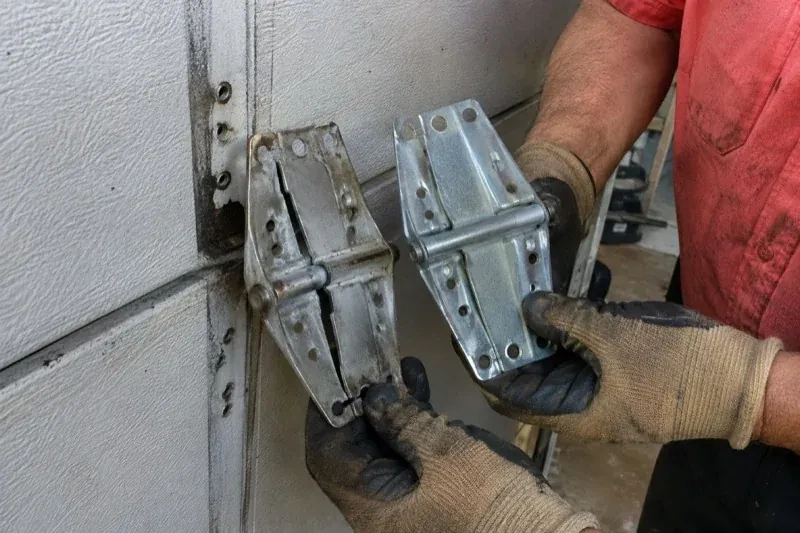
Hinges are the joints of a sectional garage door. Each pair of panels is connected by two hinges at the edges, which also hold the rollers, and by one or more centre hinges along the middle. Hinge replacement removes a hinge that has cracked, bent, worn loose at the pin or lost its grip on the panel and fits a matching one in its place. The technician keeps the door closed and the opener disconnected, changes each hinge on its own, checks the panels line up and the rollers sit true, and runs the door to confirm it folds around the curve as one piece.
Sound familiar?Toronto
Garage Door Hinge Replacement · Toronto
Scene 1
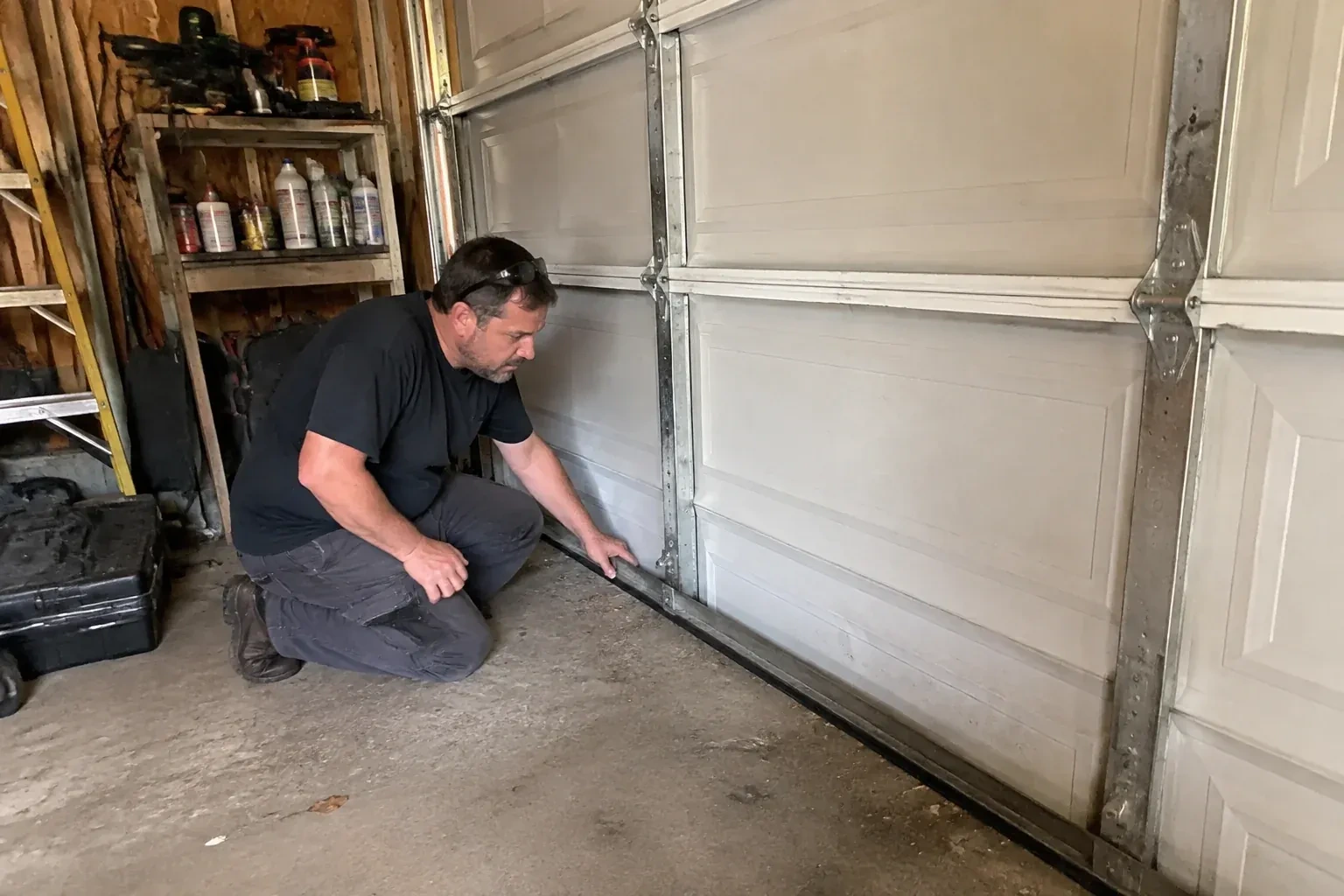
With the door still closed, the technician checks how it sits against the opening: does the door press evenly against the jambs on both sides, is there daylight at one edge, and do the panels line up flush with each other? Then the vertical tracks are checked for plumb, spacing from the door face and secure brackets, and the curve is examined for a smooth run. This matters because hinge numbers and track angle work together; a hinge of the wrong number, or a track that has crept, shows up here before the door moves. It also gives a baseline to compare against once the new hinges are on.
Scene 2
With tools out and the door still, the technician goes down the whole door: every hinge screw snugged, roller stems and hinge knuckles given a garage door lubricant, top fixtures checked for tight fasteners, and the track brackets on the jambs confirmed secure. The bottom brackets are looked at but left alone, because they anchor the lift cables and are under spring tension. Struts and their fasteners get the same pass. This sweep takes little time and usually catches the next loose screw before it becomes the next cracked hinge, so the door leaves in better shape than the single repair would suggest.
Scene 3
The maintenance checklist the door industry publishes asks homeowners to check hinges, brackets and fasteners visually from inside with the door closed, once a month. Stand where you can see both ends of the door and follow each joint with a flashlight: a screw head that stands proud, a hinge leaf lifted off the panel, a fresh crack spreading from a hole, or a rust stain running down from a knuckle. Then watch the door open and confirm the rollers stay in the track. Anything you spot is a small job at that stage. The whole check takes about a minute.
What shapes the quoteFairhaven Garage Door Services
FeesSame any hour
Yes. A stripped hole is common on older steel doors and on wood doors where the timber has softened. The technician either shifts the hinge to fresh metal within the stile, uses a larger self-drilling screw that cuts new threads, or drills through and fits a bolt with a nut and washer or a backer plate on the inside. Any of these gives the new hinge a firmer anchor than the original screws had.
Whether the door is closed, open or stuck; where the noise or the gap appears and roughly how high; whether you can see a cracked, bent or loose hinge and whether it is at the edge or the middle; whether the door is a single or a double, steel or wood, and how many panels it has; and whether anything hit the door lately. A photo of the hinge and its stamped number is useful.
Stamped galvanized steel, formed into two leaves joined by a pin or a rolled tube. The zinc coating is what resists rust in a garage that sees wet cars and salt, and it is why a scratched or bent hinge starts to brown at the damaged spot. Edge hinges include a tube that holds the roller stem. Thickness is given as a gauge, most residential hinges being 14 or 18.
TorontoOntario
Garage Door Hinge Replacement · Fairhaven, Humberlea, Kingsview Village, Martin Grove Gardens, Pine Point, Princess Anne Manor, Richview Gardens, St. Phillips, Westmount, Weston
Every square is one home in a hundred.
On-site assessment preferred · (289) 804-2651, open 24/7